NOAA Ocean Explorer - Website Design and Content Structure
UX/UI Designer | Urban Emu
The NOAA Ocean Explorer website is the public-facing digital platform for the Ocean Exploration program within the National Oceanic and Atmospheric Administration (NOAA). Its purpose is to share ocean exploration missions, scientific discoveries, multimedia, educational resources, and expedition coverage with a broad global audience; including students, educators, researchers, and the general public. The site serves as an interactive, authoritative archive of deep-sea exploration and science communication.
Hi-Fidelity Wireframes
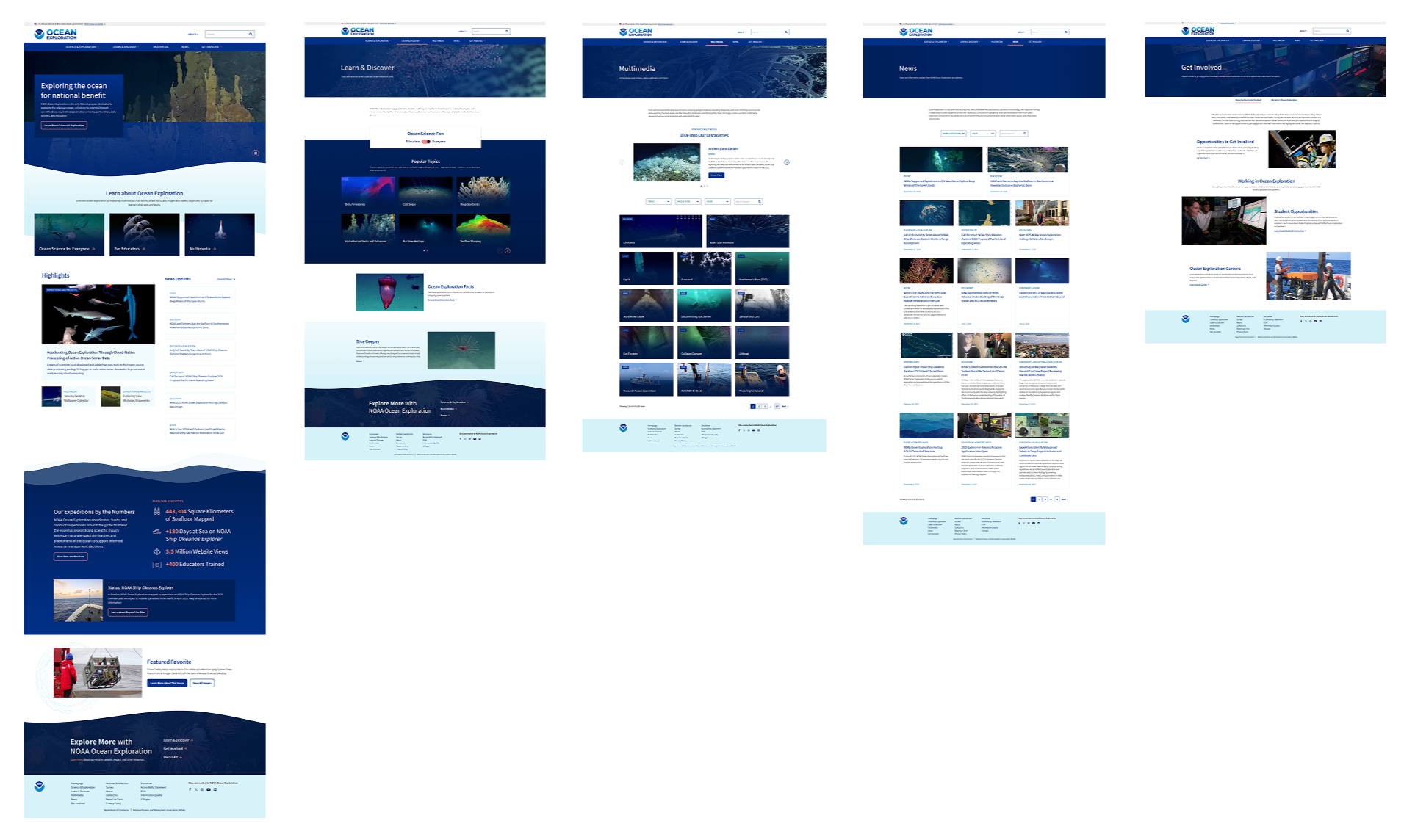
The design and experience focus on clarity, accessibility, and engagement, reflecting the mission to make complex scientific exploration understandable and inspiring:
Audience-centric content: The site speaks to diverse user groups—from curious learners to scientific professionals—by organizing rich technical content into approachable stories, multimedia galleries, and educational materials.
Visual storytelling: Strong use of high-quality images, video, and expedition highlights reinforces content and invites exploration. Multimedia elements are paired with contextual text to make science tangible and exciting.
Mission-aligned tone: The overall visual and editorial tone reflects NOAA’s scientific credibility while fostering public curiosity about ocean discovery and stewardship.
Low-Fidelity Wireframes
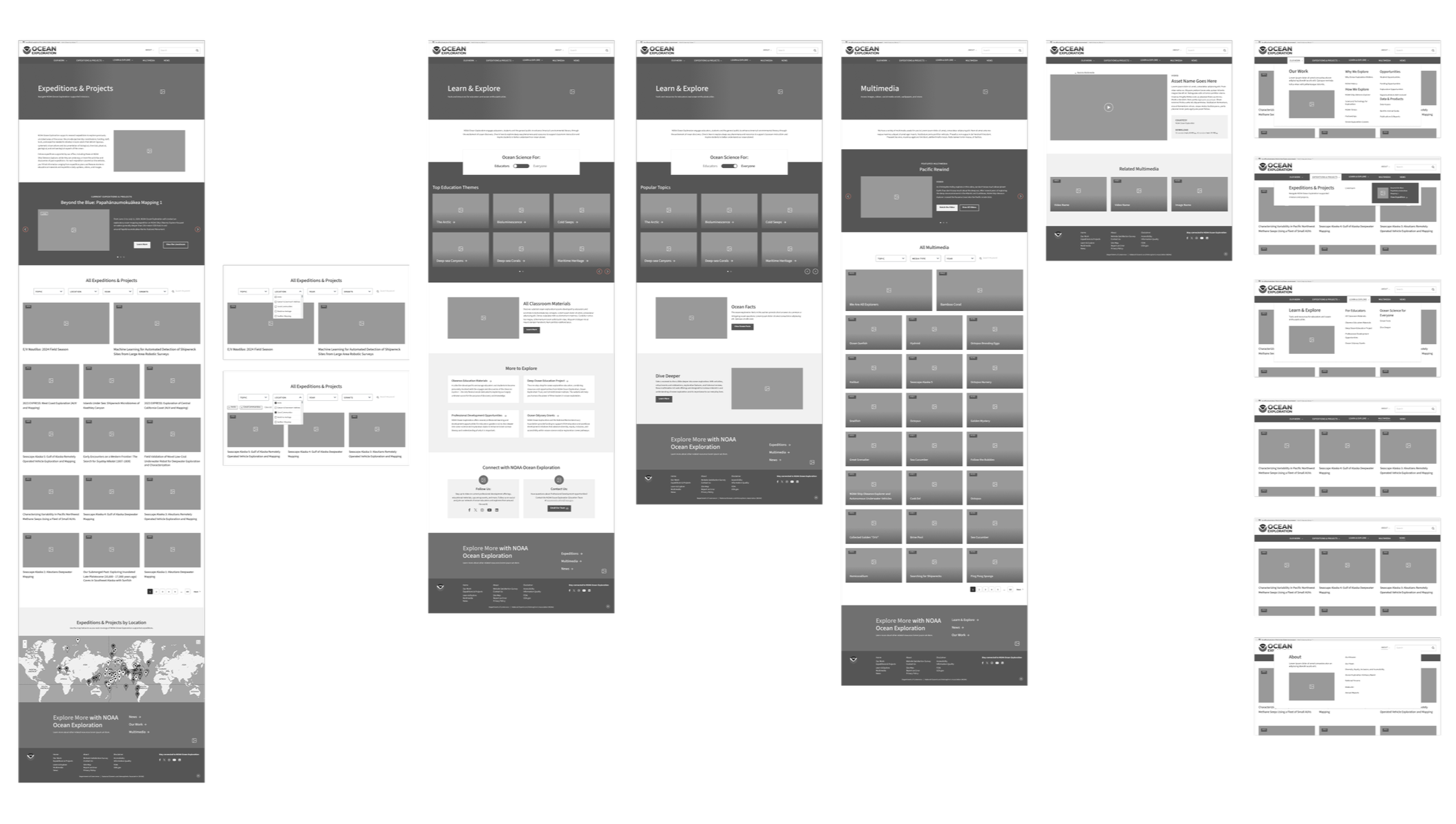
In creating the LOFI (Low-Fidelity) concepts for NOAA, I began by researching the agency’s visual identity system and broader mission to ensure the proposed interface directions aligned with how NOAA communicates complex environmental data to the public. As a federal science agency responsible for monitoring oceanic and atmospheric conditions, NOAA’s work exists at the intersection of accessibility, accuracy, and public trust . I wanted the early design directions to reflect that balance — simplifying interaction patterns without compromising the clarity or credibility expected from a scientific institution.
Initial LOFI explorations focused on intuitive data hierarchy and modular layout systems that could support large volumes of environmental content across audiences ranging from researchers to the general public. Following stakeholder review, client feedback indicated a need for clearer differentiation between educational content and live environmental datasets. In response, I pivoted the layout structure to introduce stronger visual separation through containerization and revised navigation groupings, which ultimately improved scannability and reduced cognitive load during usability walkthroughs.
Additional feedback highlighted opportunities to better surface ecosystem interconnectivity — a core concept reflected in NOAA’s own emblem, which symbolizes the relationship between Earth systems such as ocean and atmosphere . I iterated on the LOFIs to incorporate more flexible content modules that could visually reinforce these relationships through proximity-based grouping and progressive disclosure patterns.
This iterative process ensured that the final wireframe direction not only addressed stakeholder priorities but also supported NOAA’s mission-driven need to communicate complex scientific information in a way that is clear, navigable, and publicly accessible.
Information Architecture
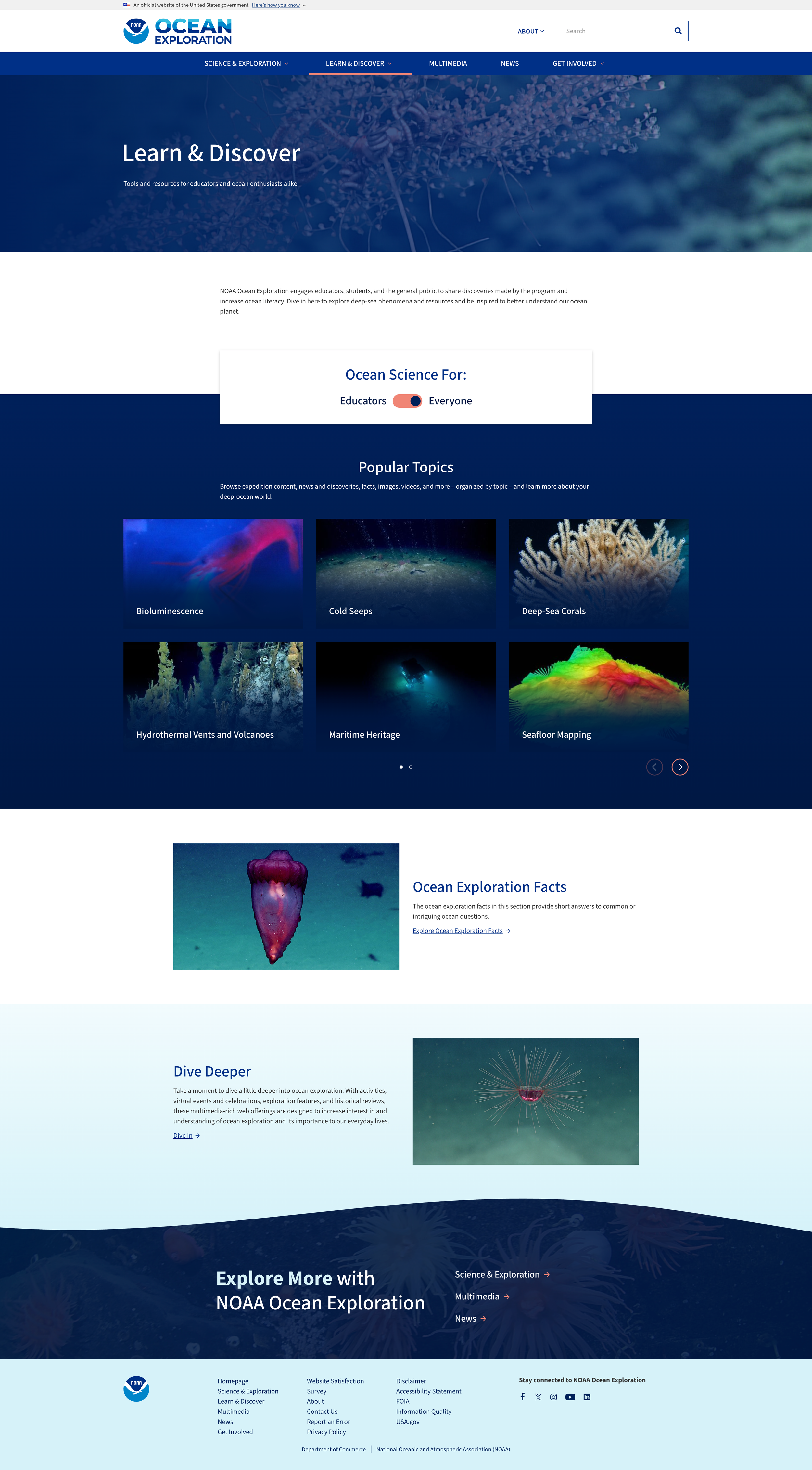
The Ocean Explorer site organizes complex data and narratives into a intuitively navigable structure:
Home / Highlights: A central hub for current expedition news, featured stories, and calls to explore further content.
About & Mission: Clear contextual grounding about NOAA Ocean Exploration’s purpose—exploring the unknown ocean and advancing scientific understanding for public good.
Expeditions: Mission-specific pages detailing objectives, discoveries, and expedition logistics with visual documentation and summaries.
Education & Multimedia: Resources tailored for learners and educators including ocean facts, lesson plans, videos, and photo galleries.
News & Updates: A regularly updated feed of discoveries, events, and opportunities to engage with ongoing projects.
This structure helps diverse visitors quickly locate the information or experience they care about, whether they’re browsing live missions, learning with students, or accessing deep-dive scientific content.
Outcome
The NOAA Ocean Explorer website functions as an accessible and authoritative portal to the deep ocean. It successfully integrates rich content with educational storytelling to:
Communicate scientific discoveries in an engaging, visual format;
Provide freely available resources that educators and institutions can reuse;
Support NOAA’s mission of public transparency and broader ocean literacy;
Invite global audiences to connect with ongoing exploration efforts.
Whether users are following live expeditions, browsing deep-sea imagery, or accessing educational materials, the site serves as a bridge between complex scientific work and public engagement.